

India’s architectural identity has been shaped by imperial capitals, royal courts, places of worship, public institutions and ambitious modern construction. Some buildings are famous for their beauty, while others are important because they represent a particular period in Indian history or continue to serve an important public function. From Mughal marble craftsmanship and Rajput palace façades to Victorian Gothic railway architecture and post-Independence civic design, India has no shortage of recognizable landmarks. This list focuses on buildings that combine architectural distinction, historical importance, public recognition and continuing relevance in 2026. The numbering is editorial rather than a scientific ranking, since there is no official system for deciding which Indian building is the most famous. Let’s check out 10 famous buildings in India in 2026 and understand what makes each one stand out.
1. Taj Mahal, Agra
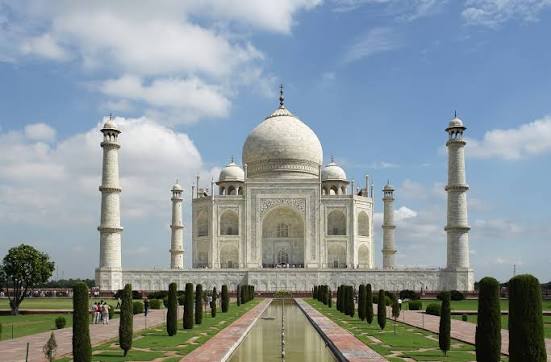
The Taj Mahal remains India’s most internationally recognizable building and one of the clearest symbols of Mughal architecture. Commissioned by Emperor Shah Jahan in memory of Mumtaz Mahal, the white-marble mausoleum was built in the 17th century as the centrepiece of a carefully planned complex on the Yamuna River. Its reputation rests not only on the central dome and four minarets but also on the extraordinary balance of symmetry, calligraphy, marble carving and pietra dura inlay. UNESCO describes it as a major achievement of Indo-Islamic architecture. Even after centuries of global fame, the Taj Mahal remains a working heritage site whose conservation, visitor management and environmental protection continue to receive close attention.
2. Rashtrapati Bhavan, New Delhi
Rashtrapati Bhavan is one of India’s most important civic buildings and the official residence of the President of India. Originally designed as the Viceroy’s House during the creation of New Delhi, it became Rashtrapati Bhavan after India became a republic in 1950. Sir Edwin Lutyens designed the main structure, but its appearance is not simply European. The vast dome, chhatris, chajjas, stone screens and use of sandstone draw from Indian architectural traditions as well. The building has 340 rooms and forms the ceremonial focus of the presidential estate. Its significance in 2026 comes from the unusual combination of monumental architecture, constitutional importance and continuing use at the centre of the Indian state.
3. Mysuru Palace, Mysuru
Mysuru Palace, also known as Amba Vilas Palace, is one of India’s best-known royal buildings. The present palace was completed in the early 20th century after an earlier wooden palace was destroyed by fire. Designed by British architect Henry Irwin, the structure is generally described as Indo-Saracenic, with Rajput, Islamic, Gothic and other influences visible in its domes, arches, towers and richly decorated interiors. Stained glass, carved doors, painted ceilings and ceremonial halls reinforce its association with the Wadiyar dynasty. The palace is especially famous for its illuminated appearance during evenings and the Mysuru Dasara season. Its continued popularity shows how a former royal residence can remain a major part of a modern city’s cultural identity.
4. Hawa Mahal, Jaipur
Hawa Mahal is one of the defining images of Jaipur and one of India’s most instantly recognizable palace façades. Built in 1799 by Sawai Pratap Singh, the five-storey structure is famous for its honeycomb-like front filled with small jharokhas and screened openings. The design allowed women of the royal household to observe activity in the streets while remaining unseen, while the openings also promoted air movement through the building. Its form combines Rajput and Mughal architectural features, including domed canopies, arches and delicate latticework. Hawa Mahal forms part of the historic character of Jaipur’s walled city, which is itself a UNESCO World Heritage property. More than two centuries later, the façade remains one of the strongest visual symbols of Rajasthan.
5. Chhatrapati Shivaji Maharaj Terminus, Mumbai
Chhatrapati Shivaji Maharaj Terminus, formerly Victoria Terminus, is both a major railway station and a landmark of late-19th-century Mumbai. Designed by F. W. Stevens and constructed over about a decade from 1878, the building combines Victorian Gothic Revival ideas with elements drawn from Indian architectural traditions. Its stone dome, turrets, pointed arches, carved details and dramatic skyline helped define the image of colonial-era Bombay. Unlike many historic structures that survive mainly as monuments, CSMT continues to function as an important transport hub. UNESCO inscribed it as a World Heritage Site in 2004, recognizing the way European and Indian design traditions were brought together in a building that remains deeply connected to the daily life of Mumbai.
6. Victoria Memorial, Kolkata
Victoria Memorial is one of Kolkata’s most famous monumental buildings and a major museum of India’s colonial period. Conceived after Queen Victoria’s death in 1901, the memorial was designed by architect William Emerson and opened to the public in 1921. The structure is built largely in white marble and draws heavily on classical and Renaissance ideas while also incorporating features suited to the Indian setting. Its large central dome, formal gardens and sculptural decoration give it a ceremonial scale that separates it from the surrounding cityscape. Today the building functions as a museum and cultural institution rather than simply a memorial. Its importance lies in both its architecture and the opportunity it provides to examine the complicated history of the British Raj through collections, exhibitions and public interpretation.
7. Lotus Temple, New Delhi
The Lotus Temple is one of the most distinctive modern religious buildings in India. Officially the Bahá’í House of Worship in New Delhi, it was dedicated to public worship in 1986. Architect Fariborz Sahba shaped the building around the form of a lotus, using repeated petal-like shells clad in white marble. The design is organized around the number nine, a feature reflected in the entrances and surrounding pools. Inside, the space is intentionally simple and free of icons, pulpits and altars, consistent with the Bahá’í idea of a house of worship open to people of all backgrounds. Its sculptural form made it a modern Delhi landmark almost immediately, and it remains notable for showing how religious symbolism can be expressed through contemporary engineering and architectural geometry.
8. Vidhana Soudha, Bengaluru
Vidhana Soudha is the seat of Karnataka’s legislature and one of the most recognizable government buildings constructed in independent India. Rising prominently in central Bengaluru, it is commonly associated with neo-Dravidian architecture and uses monumental columns, domes, decorative stonework and strongly symmetrical mass. The building was developed in the 1950s and has become closely identified with Karnataka’s political and civic life. Its importance is not limited to government administration: the exterior has long served as a visual shorthand for Bengaluru in public imagery, tourism and state ceremonies. Karnataka Tourism continues to present Vidhana Soudha as a major architectural attraction, including guided visitor initiatives. In a country rich in historic palaces and forts, it stands out as a post-Independence landmark built to express the authority of a democratic state.
9. Sansad Bhavan, New Delhi
India’s new Parliament building, officially Sansad Bhavan, is one of the country’s most significant recent public buildings. Dedicated to the nation in May 2023, it began hosting parliamentary proceedings later that year. The triangular complex was designed to provide larger and more technologically equipped Lok Sabha and Rajya Sabha chambers while responding to the long-term needs of Parliament. Its interiors use Indian artistic and symbolic references, including motifs connected with the peacock, lotus and banyan tree. The building also includes a Constitution Hall and spaces intended to present aspects of India’s democratic and cultural heritage. By 2026, Sansad Bhavan has become a working national institution rather than simply a new landmark, giving it a different kind of fame from older monuments: its architecture is tied directly to current lawmaking and public life.
10. Umaid Bhawan Palace, Jodhpur
Umaid Bhawan Palace dominates the Jodhpur skyline and represents a very different phase of Indian palace architecture from the older Rajput forts and havelis. Construction began under Maharaja Umaid Singh around the end of the 1920s, partly as an employment-generating project during a period of severe hardship and drought. Designed by British architect H. V. Lanchester, the palace uses sandstone and blends Classical, Indo-Saracenic and Art Deco influences. Its massive central dome and long symmetrical wings give it a scale that feels both royal and distinctly 20th century. The property today combines a royal residence, museum and luxury hotel functions. That unusual continuity—from princely project to living heritage property—helps keep Umaid Bhawan among the most famous palace buildings in India.
Why These Buildings Continue to Matter in 2026
These buildings are famous for different reasons, which is exactly what makes Indian architecture so varied. The Taj Mahal, Hawa Mahal and Mysuru Palace are closely associated with historic dynasties and craftsmanship. Rashtrapati Bhavan, Vidhana Soudha and Sansad Bhavan remain active centres of public authority. Chhatrapati Shivaji Maharaj Terminus proves that a heritage building can still serve millions of modern commuters, while Victoria Memorial operates as a museum and the Lotus Temple continues its religious role. Umaid Bhawan Palace has adapted to contemporary hospitality without losing its identity as a royal residence. Together, these structures show that architectural fame is not based on age alone. Continuing use, conservation, public memory and a strong visual identity can be just as important as historical origin.
Conclusion
India’s most famous buildings span several centuries and cannot be reduced to a single architectural tradition. The white marble of the Taj Mahal, the honeycomb façade of Hawa Mahal, the Gothic mass of CSMT, the lotus form of a modern Bahá’í temple and the monumental civic scale of Vidhana Soudha and Sansad Bhavan all represent different moments in the country’s built history. What keeps these buildings relevant in 2026 is that they are still seen, visited, used, studied and debated. Some function as national institutions, some preserve royal or colonial history, and others remain places of worship or public transport. Their lasting fame comes from the way architecture, history and public life continue to meet in the same physical spaces.